
How to fold a suit without damaging it: the practical guide
Whether for a business trip, a wedding on the other side of the country, or a weekend where you need to look your best, your suit must travel with you. And as you know, a poorly packed suit is a disaster waiting to happen upon arrival. Good news: with the right techniques and a few clever accessories, your suit can travel across the country without ending up looking like a crumpled rag. Here is everything you need to know.
Subheading
Heading
Use this text to share information about your brand with your customers. Describe a product, share announcements, or welcome customers to your store.
Why folding a suit requires special attention
A suit is not a t-shirt. The shoulders are structured, the fabric is often delicate, and every misplaced crease will show during your important meeting.
The secret to successful folding relies on three principles:
Protect sensitive areas. The shoulders and lapels are the most fragile parts—and the ones that are most noticeable if they are damaged.
Minimize stress points. Fabric folded too tightly will retain creases. The goal is to create natural folds, not sharp breaks.
Use the right accessories. A suitable garment bag makes all the difference between a presentable suit and one that is ready for the dry cleaners.

Method 1: The "shoulder-in-shoulder" fold (the most effective)
This is the preferred technique of business travelers and tailors. It perfectly protects the shoulders and lapels.
- Lay your jacket flat, outer side facing you
- Turn one shoulder inside out, placing your hand inside to maintain the shape of the shoulder pad
- Slide the other shoulder inside the first—the two shoulders are now nested, inner side against inner side
- Smooth out the back of the jacket. The lapels are now protected inside
- Fold the jacket in half lengthwise
Result: A compact jacket with its sensitive parts (shoulders, lapels, buttons) completely protected.
Ideal for: Carry-on suitcases, travel bags, long journeys.

Method 2: Rolling (for small luggage)
Counter-intuitive but incredibly effective. Rolling prevents deep creases because it does not create any sharp breaks in the fabric.
- First, perform the "shoulder-to-shoulder" fold described above
- Instead of folding the jacket in half, roll it gently from the bottom up to the shoulders
- Do not pull too tight; the roll should remain soft
Ideal for: Backpacks, very limited luggage, short trips.
Note: This method works best with soft fabrics (unstructured wool, wool-linen blends). Highly structured suits prefer the classic fold.

Method 3: The garment bag fold
If you have a garment bag, this method is the simplest and safest.
- Button your jacket completely
- Turn it inside out (the lining becomes the exterior)
- Fold the sleeves across the back, parallel to one another
- Fold the jacket in half or in thirds depending on the size of your bag
- Slide it into the garment bag, with the trousers on top
Ideal for: Car trips, train travel, and commutes where you can keep the garment bag close at hand.
And the trousers?
Trousers are often overlooked. Yet, wrinkled trousers are just as noticeable as a rumpled jacket.
- Align the two legs by overlapping the existing creases
- Fold the trousers in half lengthwise, at the crotch
- Then fold into thirds: bring the hem up toward the waistband, then fold a second time
- Place the folded trousers on top of the jacket in your luggage — they will serve as a protective "cushion"
Tip: Slide a sheet of tissue paper between each fold. It will limit creasing and absorb moisture.
Accessories that make the difference
Good folding isn't everything. The right accessories turn a risky trip into a stress-free journey.
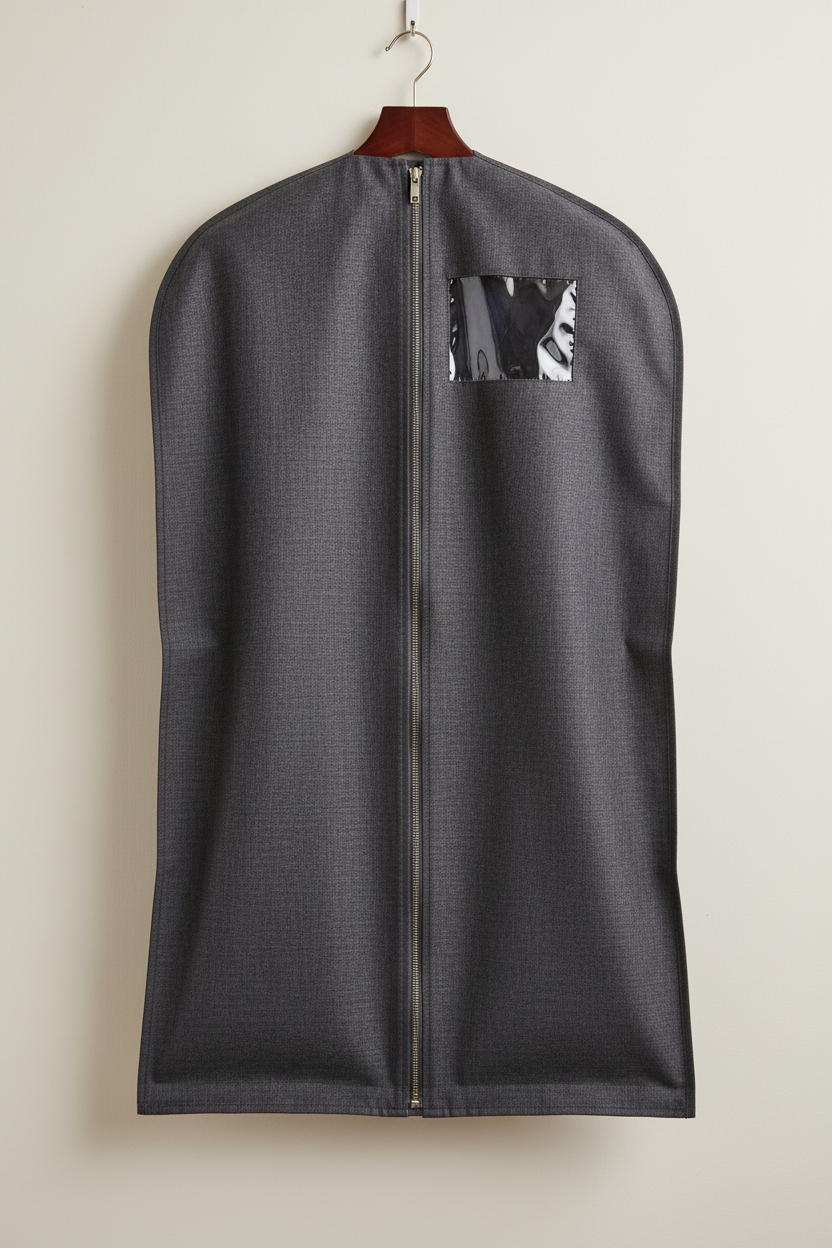
The breathable fabric garment bag:
Forget plastic dry-cleaning bags that trap moisture. Invest in a real cotton or technical nylon garment bag, long enough not to compress the jacket, with pockets for your accessories.
The travel hanger:
A folding model that slips into your suitcase. Choose a sufficient shoulder width (44-46 cm minimum). Avoid thin hotel hangers that deform the shoulders.
The compact garment steamer:
Your secret weapon for stubborn wrinkles. Move it 2-3 cm from the fabric using vertical strokes—five minutes is all it takes.
Free alternative: Hang your suit in the bathroom while you take a hot shower. The ambient steam will do the job.
The 5 mistakes that ruin a suit while traveling
Mistake #1: Packing a damp suit. Caught in the rain? Wait until it is completely dry. Moisture + folding = guaranteed mold and odors.
Mistake #2: Overpacking the suitcase. A suit crushed under shoes doesn't stand a chance. Always pack your suit last, on top.
Mistake #3: Forgetting to empty the pockets. Keys, wallet, phone... Anything left in your pockets will cause misshapen areas. Always empty them before folding.
Mistake #4: Storing shoes with the suit. Shoe polish, dust, and moisture are your suit's enemies. Always pack your shoes separately.
Mistake #5: Waiting to unpack. The longer your suit stays folded, the more the wrinkles set in. As soon as you arrive, take it out and hang it up; even an hour on a hanger makes a difference.
Upon arrival: saving tips
Your trip is over. Here is how to bring your suit back to life.
Immediately: Take it out and hang it on a proper hanger. Gently tug on the fabric to realign the fibers.
If wrinkles persist: Use your garment steamer or the bathroom steam technique. Light wrinkles will disappear in minutes.
As a last resort: The hotel's dry cleaning service often offers express service within a few hours.
FAQ
Ideally no more than 24 to 48 hours. Beyond that, the creases start to set into the fabric.
The "shoulder-to-shoulder" fold is more universal and better protects structured shoulders. Rolling is suitable for soft suits and small luggage.
Two options: a carry-on suitcase (suit folded on top) or a garment bag. Some airlines may agree to hang it in the cabin—ask politely at boarding.
Hang it up immediately and use steam. If wrinkles persist, please have it taken to the hotel dry cleaner.