
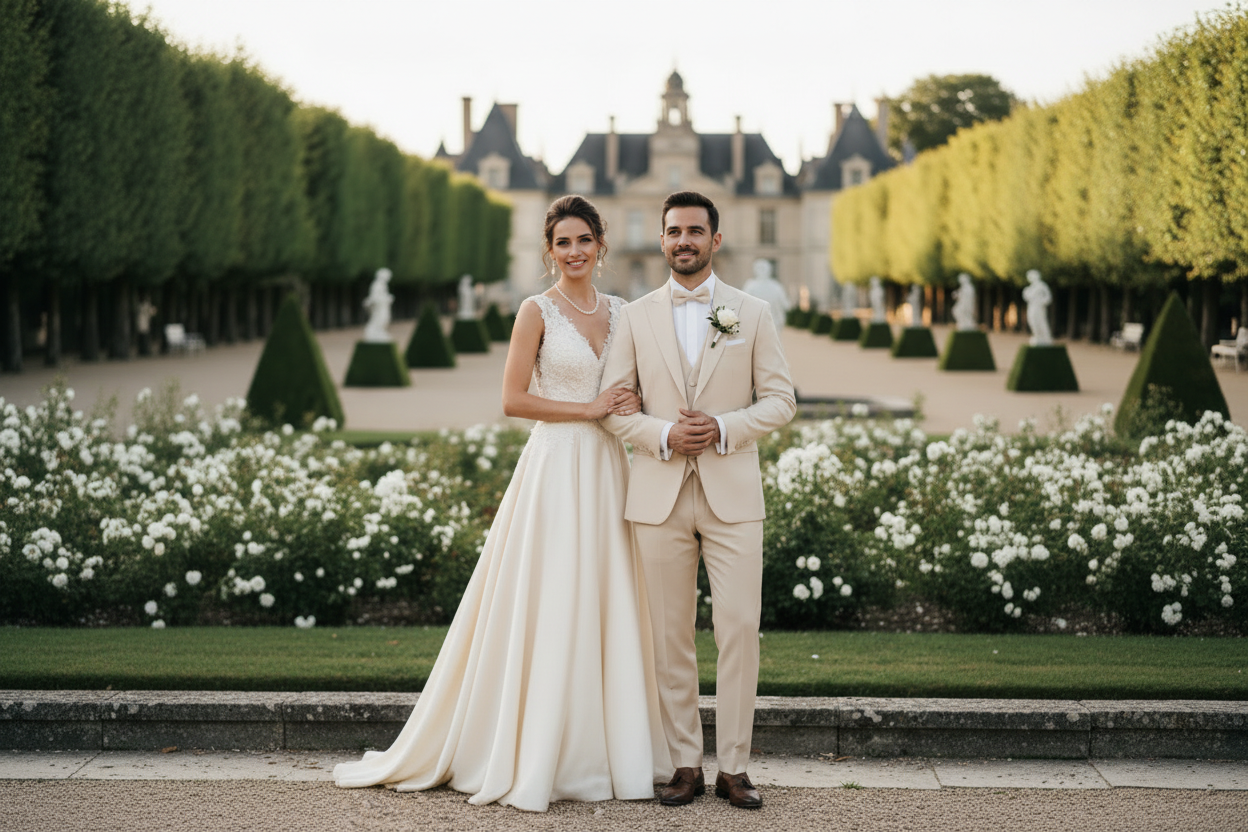
Wedding Suit: Inspiration Guide and Style Tips
Suit ideas for a wedding: Which suit for which best man, guest, or groom?
A wedding is not just a party. It is a suspended moment, a break of pure emotion where every detail counts. Whether you are the groom at the center of all attention, the best man carrying the trust of a friend on his shoulders, or a guest who has come to celebrate a union, your suit says something about you. It speaks to your respect for the event, your consideration for others, and your sense of style.
At Anthony Garçon, we believe that a wedding suit is not a uniform. It is a celebration in itself, that of a man who knows that elegance is never a burden when it is well thought out.
The suit adapts to the wedding, not the other way around
No two weddings are alike. A cocktail party at a château in the Périgord does not call for the same attire as a bohemian celebration in a Luberon barn or a civil ceremony followed by a dinner on a Parisian rooftop. Rather than presenting you with product sheets, we have imagined three complete style scenarios.
The "castle & tradition" wedding, timeless chic
Fabric suggestion:
Opt for a Super 110's or Super 120's wool cloth. These fabrics offer a subtle luster—that discreet sheen that catches the light without the "prom suit" effect of synthetic fabrics. The fineness of the fiber ensures an impeccable drape and comfort even on warm days, provided you choose an appropriate weight (250-280g for summer, 280-320g for mid-season).
The atmosphere:
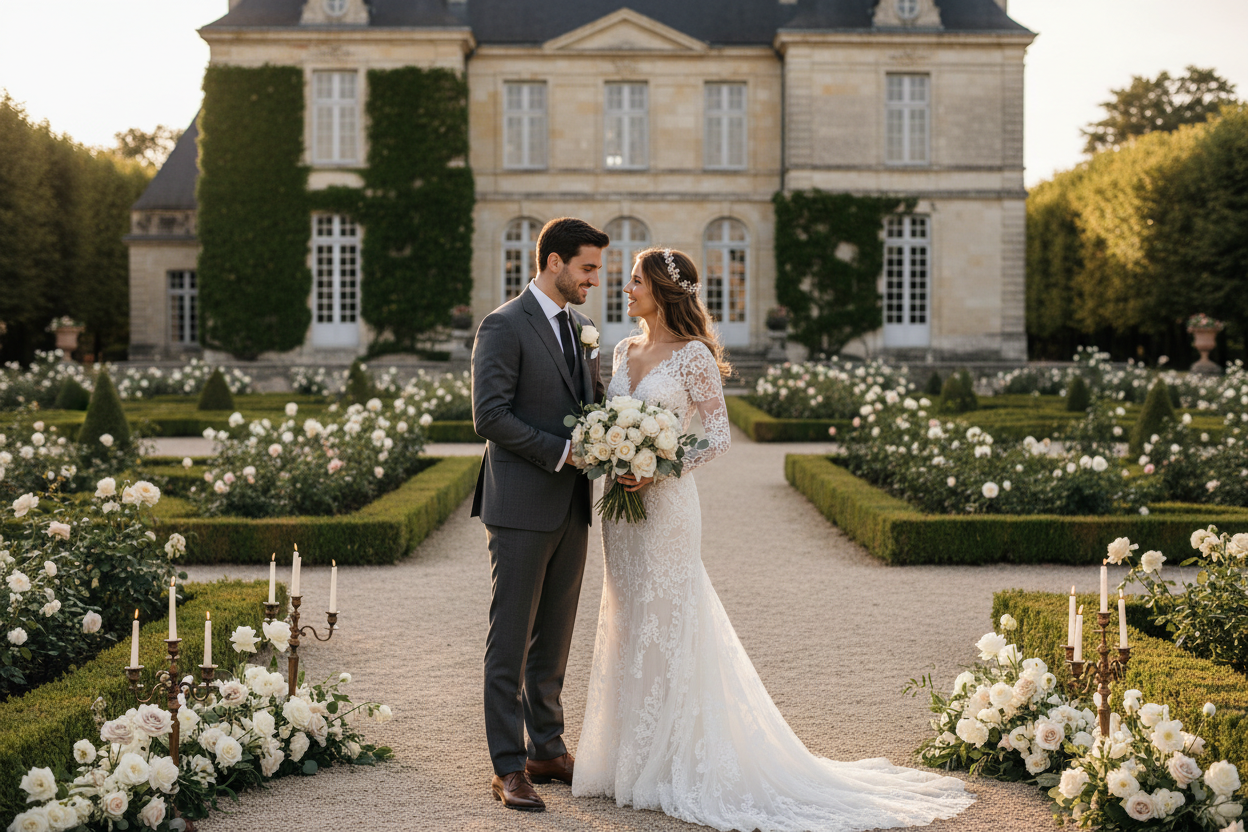
You are a guest (or the one getting married) in a classic setting that naturally dictates its own dress code. A château, manor, private mansion, or prestigious vineyard. The invitation card mentions "appropriate attire" or "cocktail." There will be a seating plan, speeches, perhaps an orchestra. Elegance is expected, and you fully intend to live up to the occasion.
The choice:
the three-piece suit. For this type of event, the three-piece suit stands out as the obvious choice. Not out of conformity, but because it offers a visual completeness that a two-piece cannot match and, above all, valuable functionality.
Why the waistcoat changes everything: At a wedding, you will inevitably move from one space to another. Solemn ceremony with jacket buttoned, garden cocktail with jacket unbuttoned, dinner and evening with jacket off. Without a waistcoat, a man in a shirt instantly loses his poise. With a waistcoat, he maintains a structured silhouette and an elegant verticality that lasts until the end of the night.
Preferred colors:
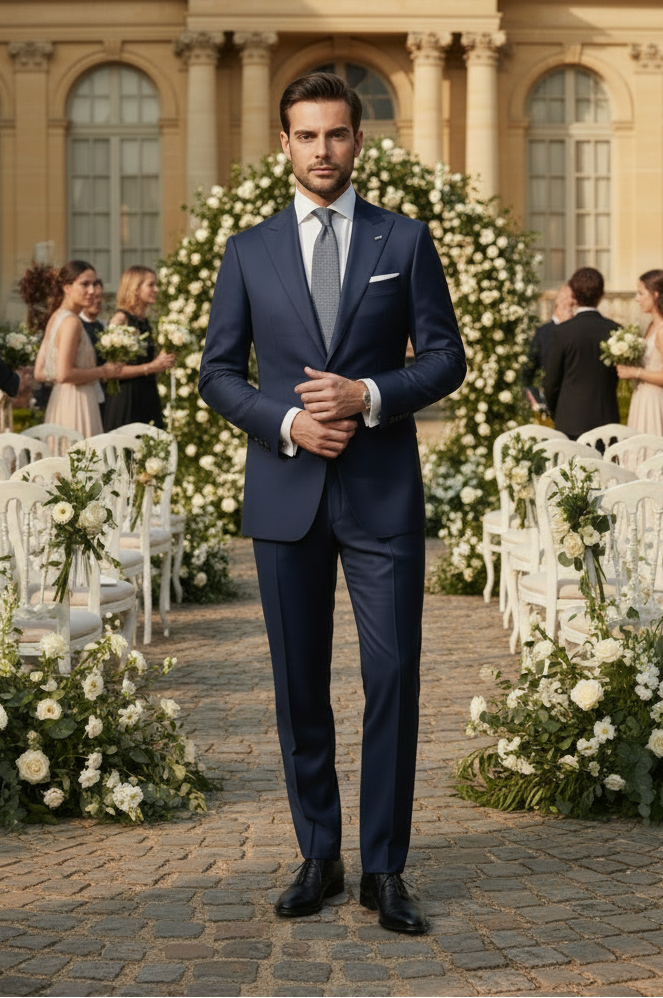
Midnight blue remains the gold standard. More sophisticated than classic navy blue, it plays with the light of candles and chandeliers to reveal deep reflections. It is the choice for the groom who wants to stand out without falling into eccentricity, and for the best man who wishes to honor his role with class.
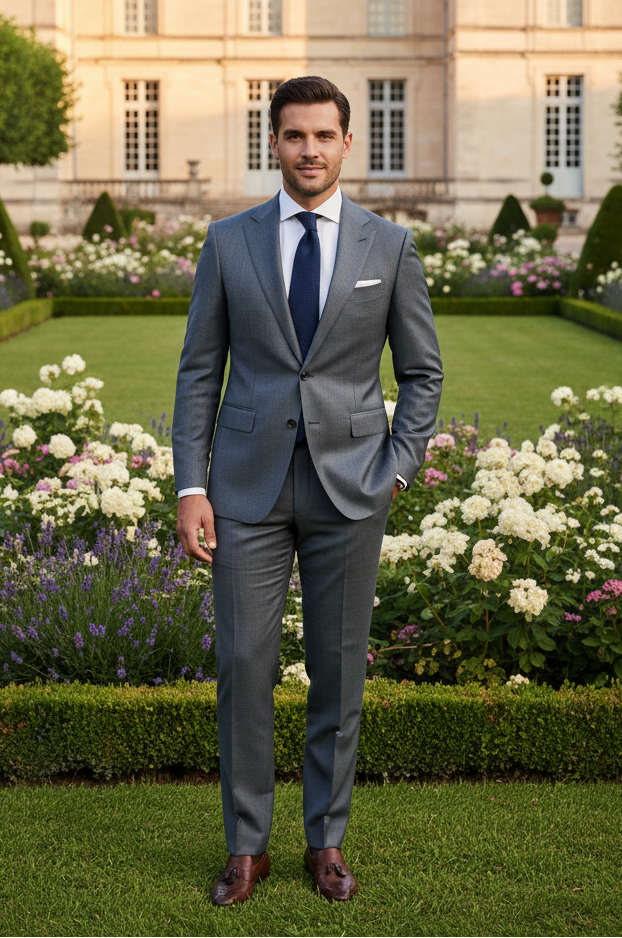
Steel grey (or medium grey) offers an alternative with cool, understated elegance. It pairs particularly well with colorful accessories (burgundy tie, antique rose pocket square) and is perfectly suited for guests who do not wish to outshine the groom.
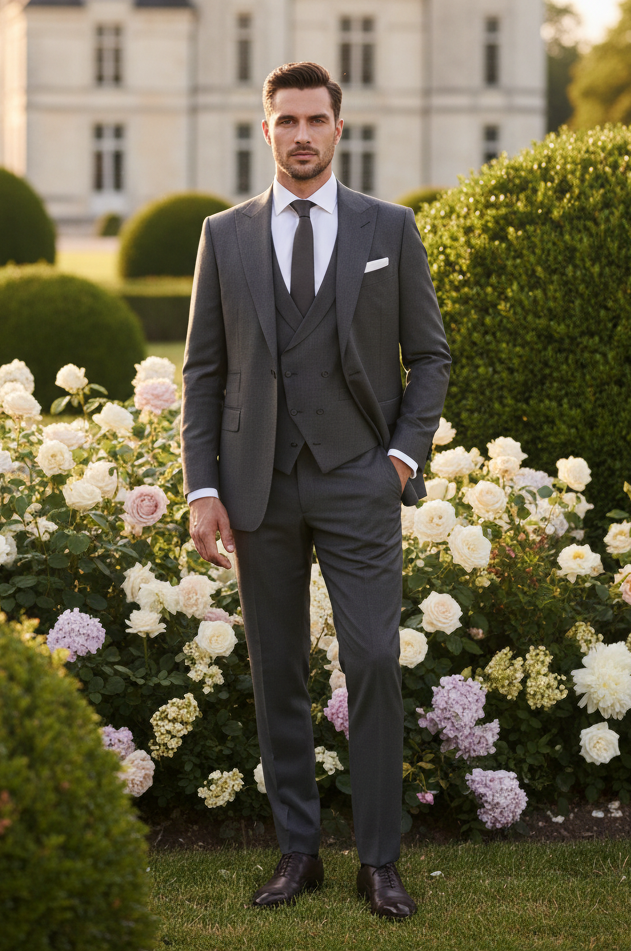
Charcoal grey brings a natural authority to evening ceremonies or autumn/winter weddings.
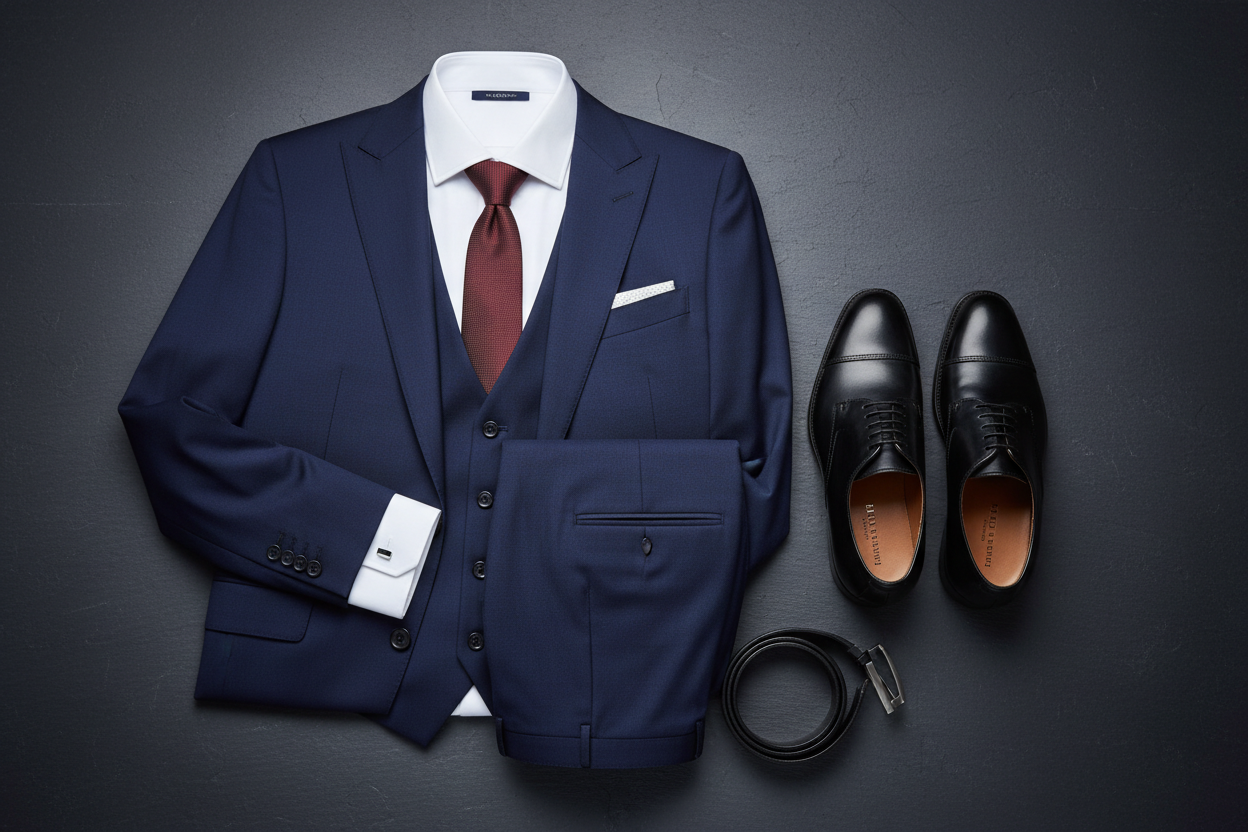
The complete ensemble:
- Midnight blue three-piece suit, slim fit
- White poplin shirt, French or cutaway collar
- Burgundy or petrol blue grenadine silk tie
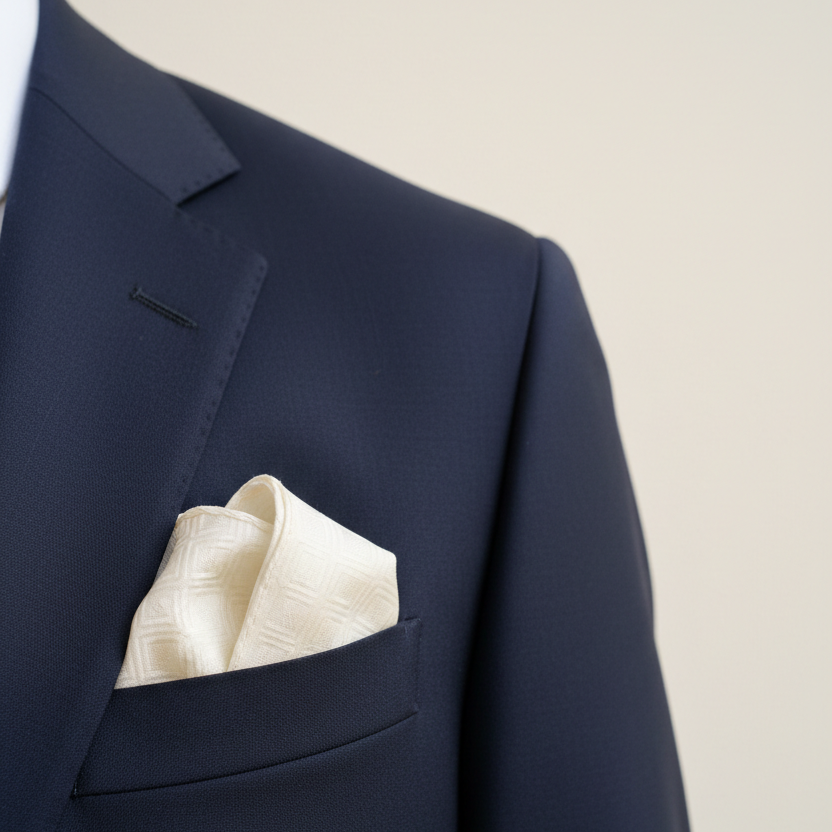
- Off-white linen or tonal patterned silk pocket square
- Black burnished leather oxford shoes
- Slim black leather belt (matching the watch buckle)
The "bohemian & rustic" wedding
The vibe:
The invitation sets the tone—guinguette, garden party, "smart casual." The venue exudes authenticity: a renovated barn, a Provençal farmhouse, a family vineyard, or the garden of a country home. The bride and groom have chosen wildflowers over sophisticated arrangements. The atmosphere will be convivial, you might find yourself with your feet in the grass, and no one will hold it against you for taking off your jacket before dessert.
Fabric suggestion:
Forget smooth wool cloth. Here, we want texture, grain, life. Wool-linen blends (60/40 or 70/30) offer that slightly wrinkled look that suits relaxed settings. Pure linen, while it wrinkles more, provides incomparable breathability for summer weddings.
The cut: unstructured but not neglected
The unstructured jacket (without rigid shoulder pads, with partial or no lining) is your ally here. It offers a softer, more natural silhouette that follows your movements without restricting you. Worn over matching trousers—but without the millimeter precision of a business suit—it embodies that "effortless" elegance that is so difficult to achieve.
Preferred colors: organic hues and living materials
Here, a strict navy blue suit would be almost out of place, too urban, too corporate. Country elegance calls for organic hues that harmonize with the natural environment:
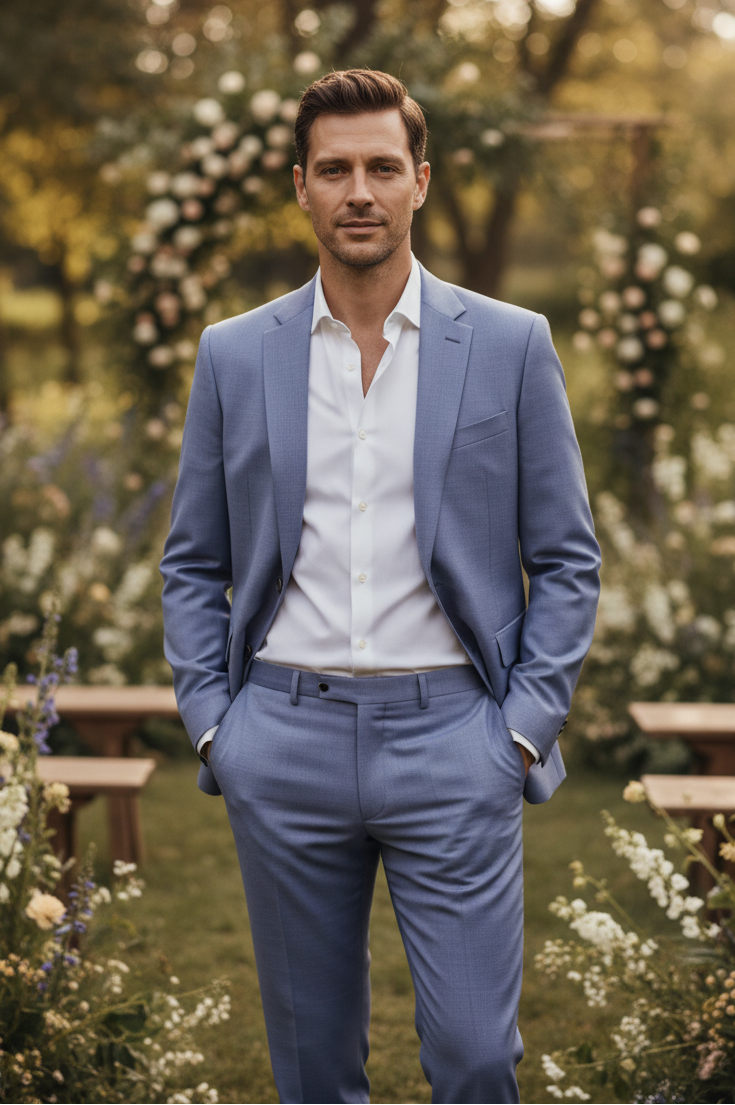
Lavender blue or faded sky blue: A softened version of classic blue, perfect for Mediterranean gardens.
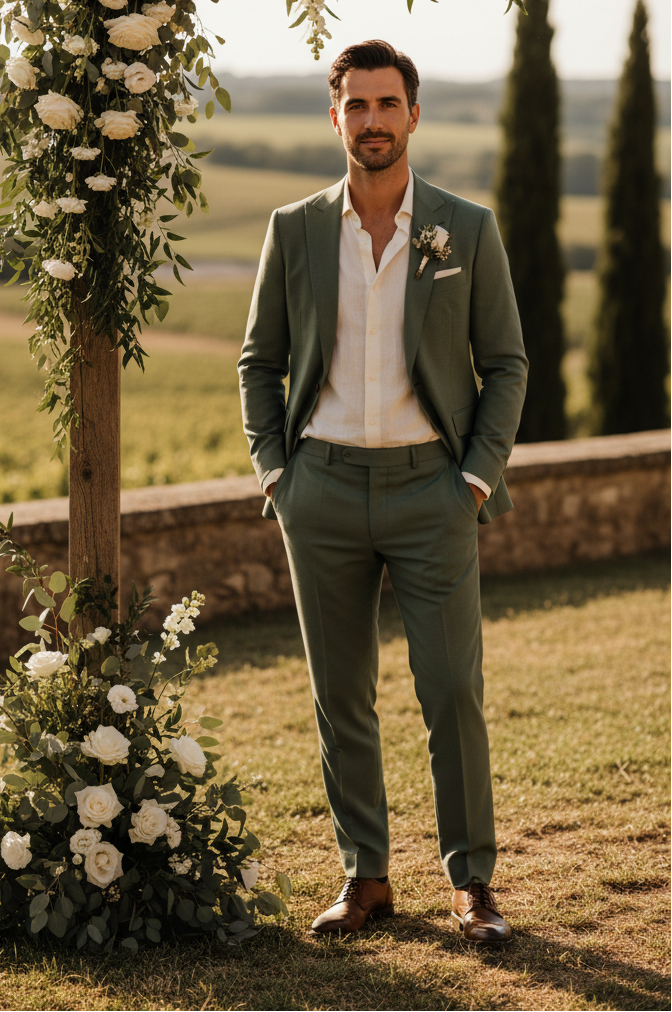
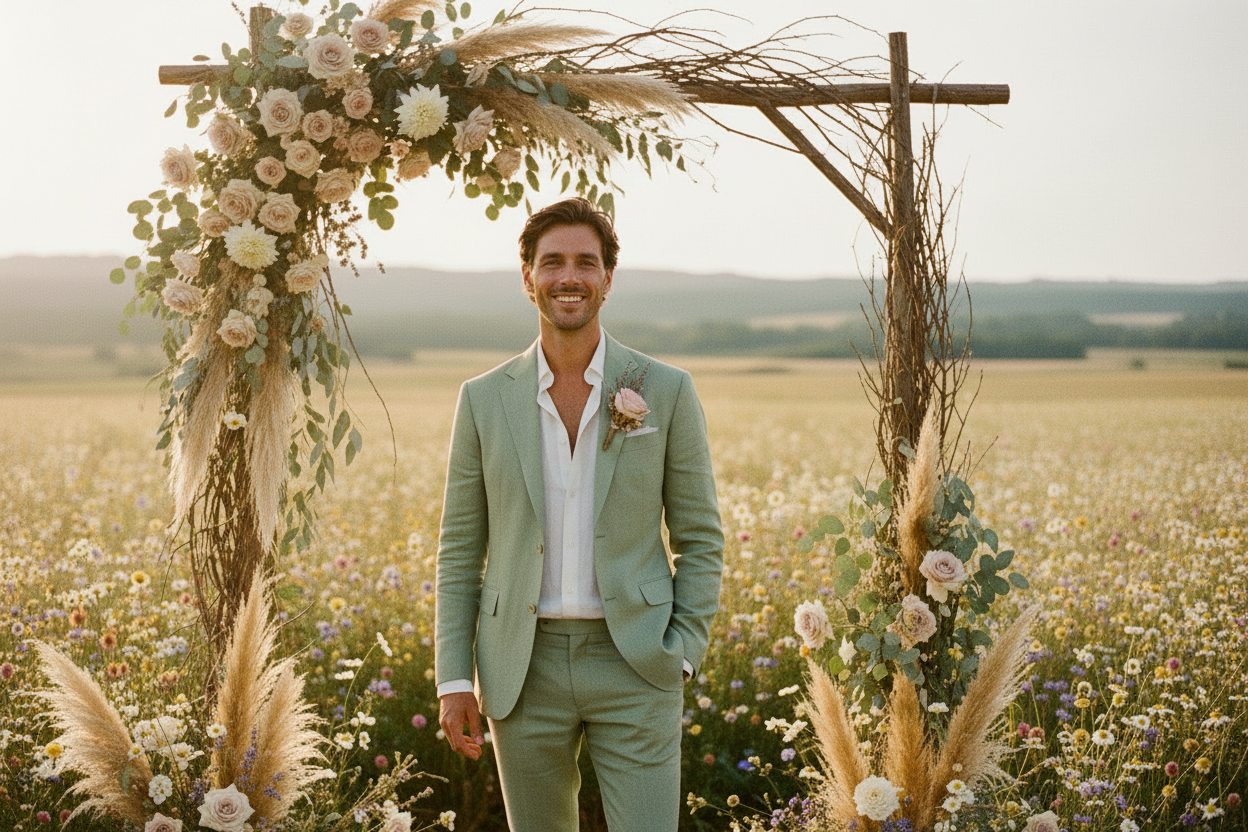
Sage green (or almond green): Bold but never gaudy, it blends perfectly with botanical decors and offers a refreshing alternative to the classic blue-grays.
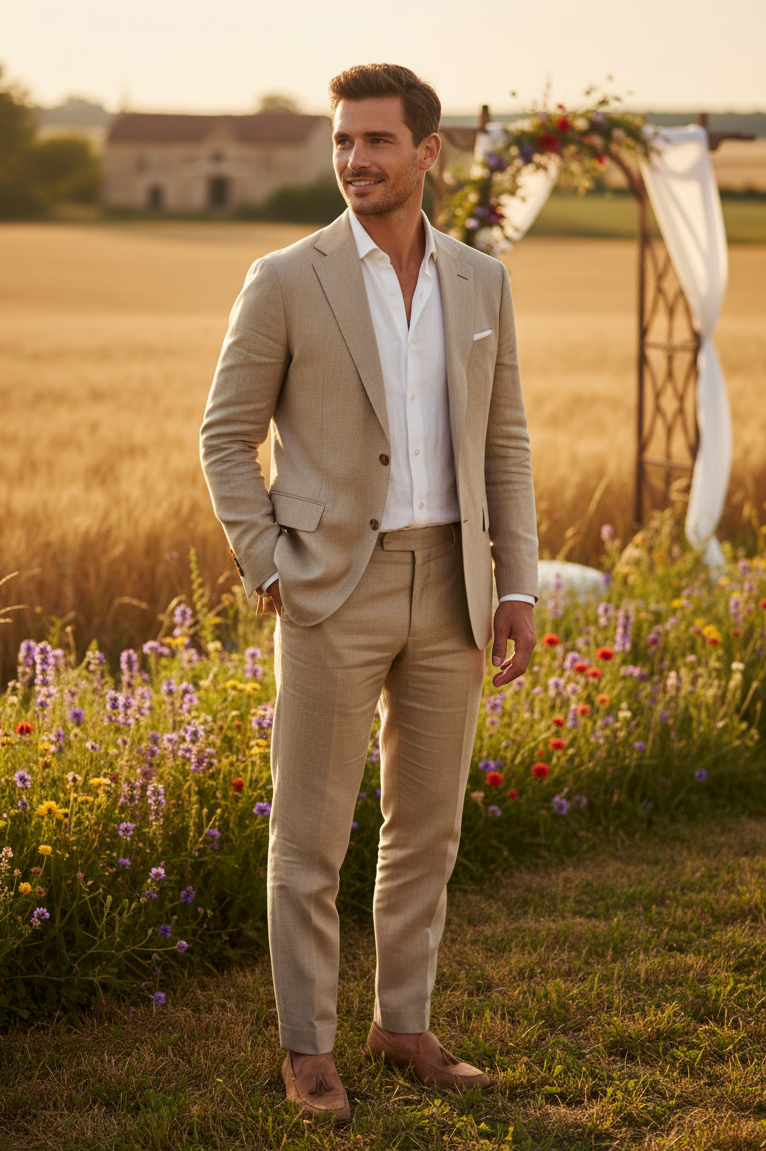
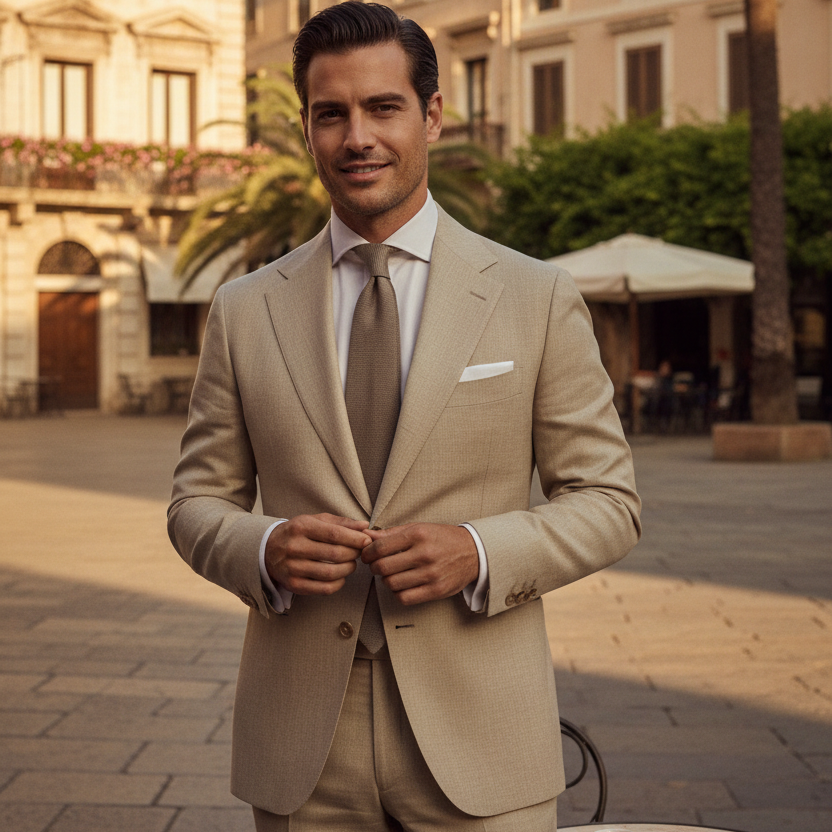
Sand beige or ecru: The obvious choice for outdoor summer weddings. Bright without being white (reserved for the bride and groom in some traditions), it exudes effortless sophistication.
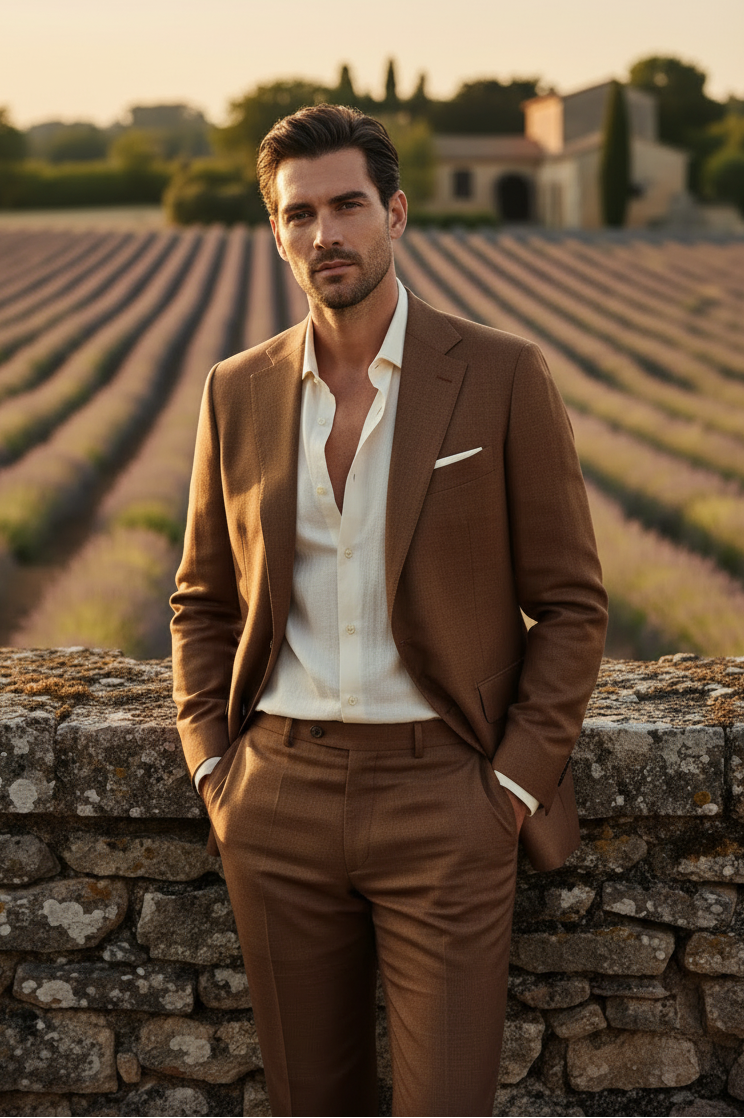
Burnt sienna or tobacco: For autumn weddings or men who embrace a warm palette. Pairs remarkably well with burgundy and cream.
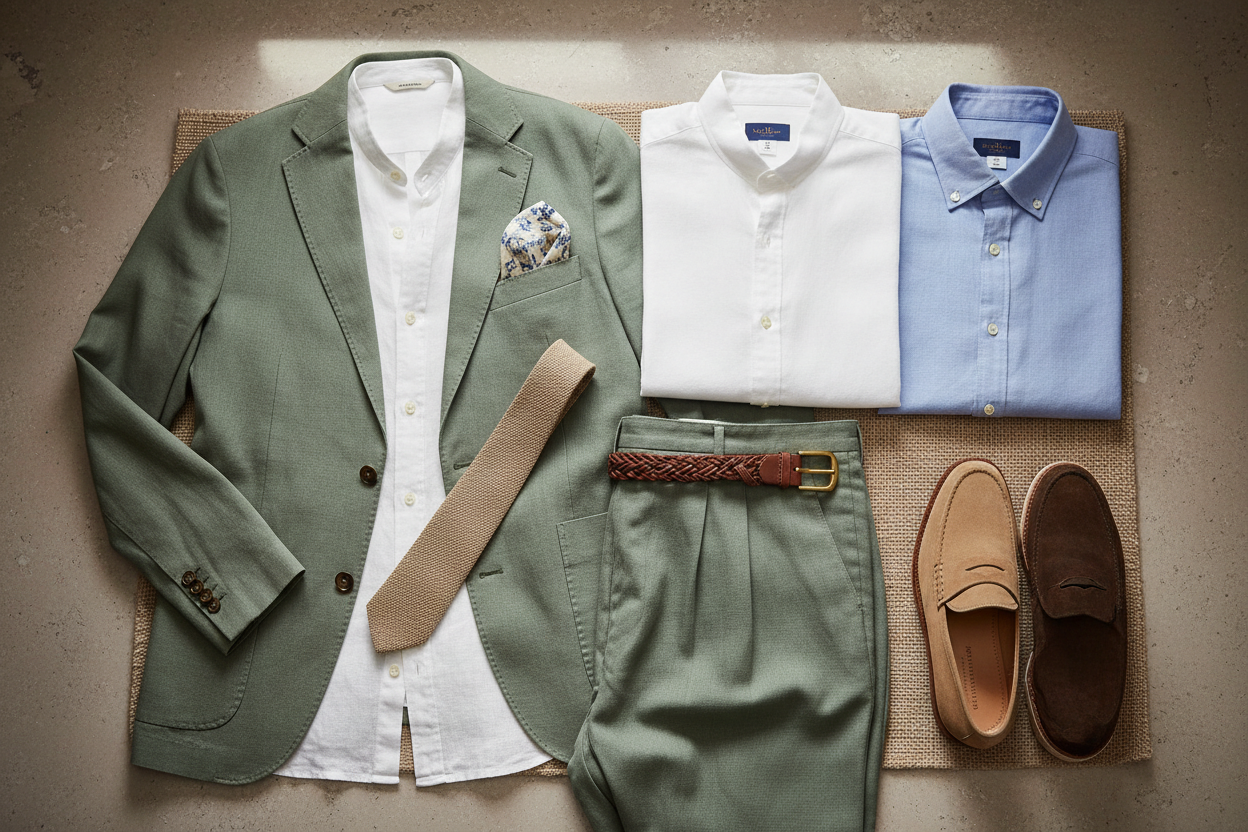
The complete ensemble:
- Unstructured sage green or beige jacket, natural shoulders
- Matching trousers, slightly loose fit, possibly pleated
- White linen or sky blue oxford shirt, open collar (no tie or cotton knit tie)
- Linen or cotton pocket square, liberty print or contrasting solid color
- Braided natural leather belt
- Suede moccasins, loafers, or derbies (dare to go sockless if the temperature allows)
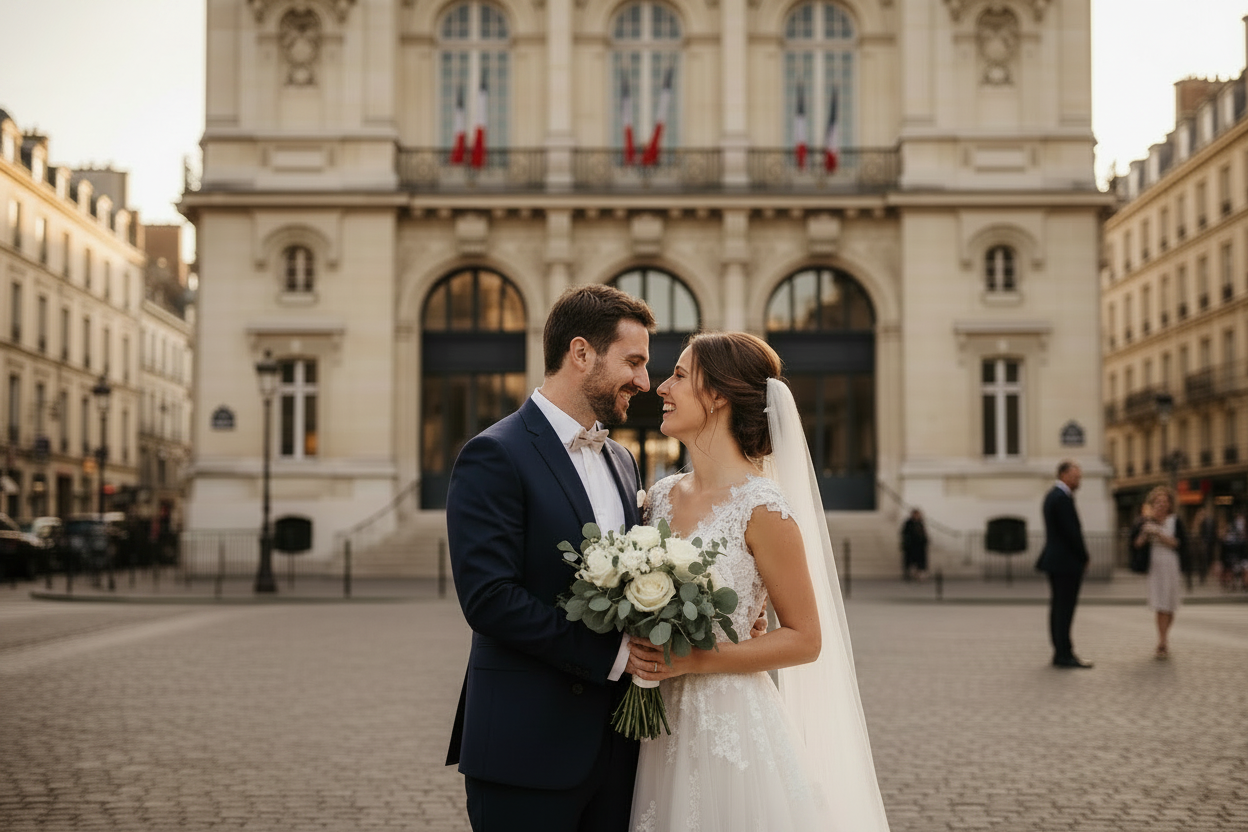
The “urban” wedding
The Vibe:
A civil ceremony at the 16th arrondissement town hall, a cocktail party in a Haussmann-style apartment, dinner at a Michelin-starred restaurant, and an after-party on a rooftop overlooking the rooftops of Paris. Or perhaps: a secular ceremony in an industrial loft, a reception in a contemporary art gallery. The bride and groom have a taste for design, architecture, and bold modernity. The dress code? "Chic," and they know you’ll know how to interpret it.
Fabric suggestion:
For a double-breasted or modern suit, opt for tightly woven wool fabrics (twill, cavalry twill) that offer a clean surface and precise lines. For a tuxedo, mohair wools or wool-mohair blends provide that tension in the fabric that makes all the difference.
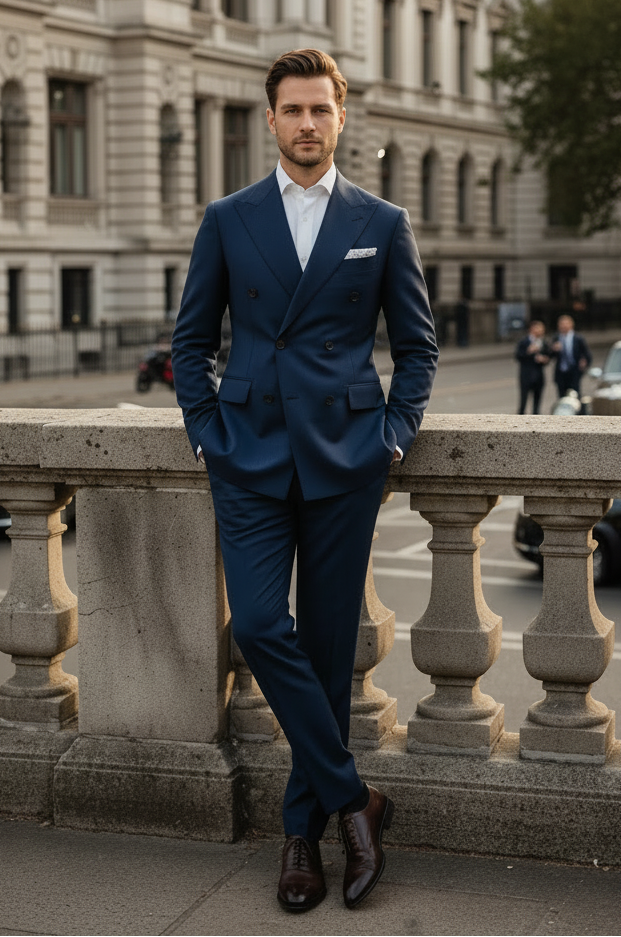
The double-breasted suit:
Long confined to our fathers' wardrobes, the double-breasted suit is making a spectacular comeback. Its architectural silhouette—wide lapels that create a powerful V-shape, and buttoning that structures the torso—commands a presence that a single-breasted suit cannot match. In midnight blue, charcoal gray, or black, it transforms the man who wears it.
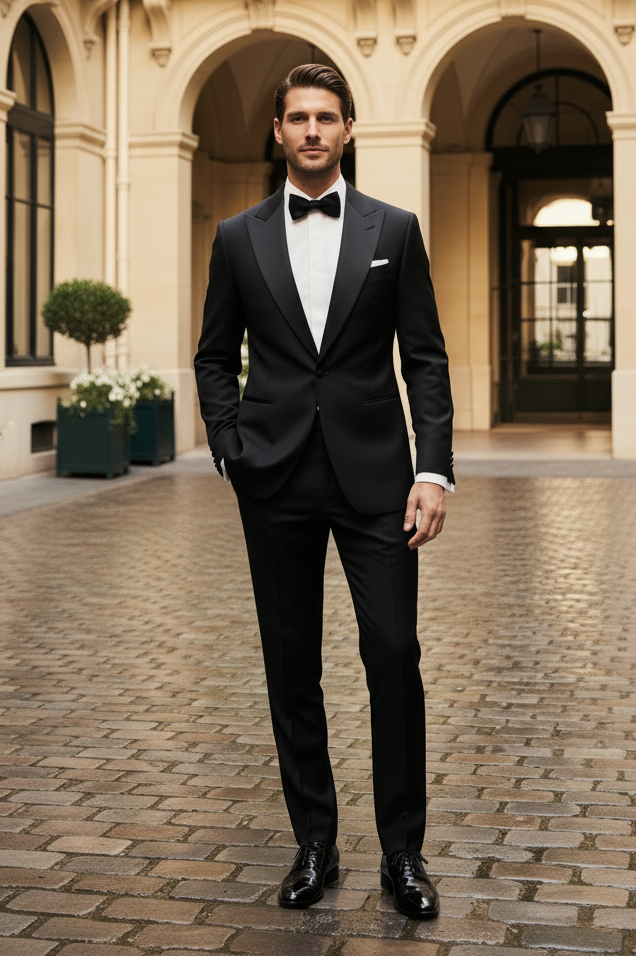
The tuxedo revisited:
If the dress code specifies "black tie," a tuxedo is a must. But not just any tuxedo. Forget rental tuxedos with cheap satin lapels. A modern tuxedo can feature narrower lapels (peak lapel or shawl collar), a slightly slimmer fit, and a matte fabric rather than a shiny one. Elegance, not a costume.
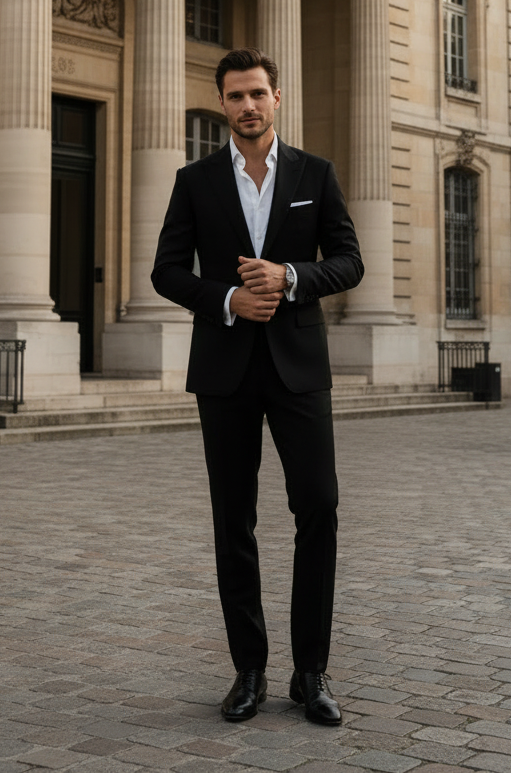
The black suit:
Controversial in traditional circles (black being historically reserved for waiters and funerals), the black suit has been rehabilitated by contemporary fashion. In an urban and modern context, worn with a pristine white shirt and minimalist accessories, it exudes an undeniable graphic power. You will just need to be careful that the bride and groom are not too stick-in-the-mud about tradition!
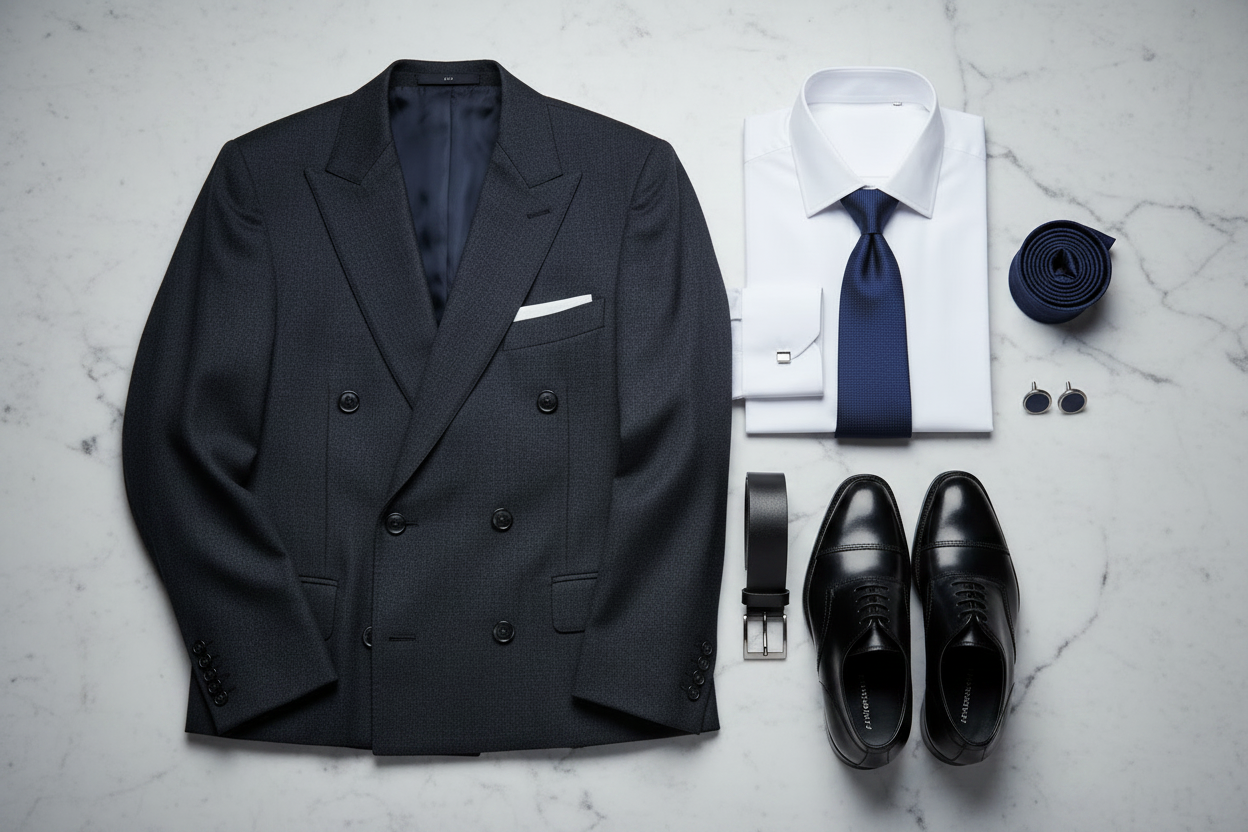
The complete outfit (double-breasted version):
- Midnight blue or charcoal grey 6-button double-breasted suit (2 to fasten)
- White poplin shirt, classic spread collar
- Woven silk tie, navy blue or black, tight knot
- White linen or silk pocket square, simple fold (TV fold or discreet puff)
- Black leather oxford shoes, mirror shine
- Discreet cufflinks, silver or gunmetal
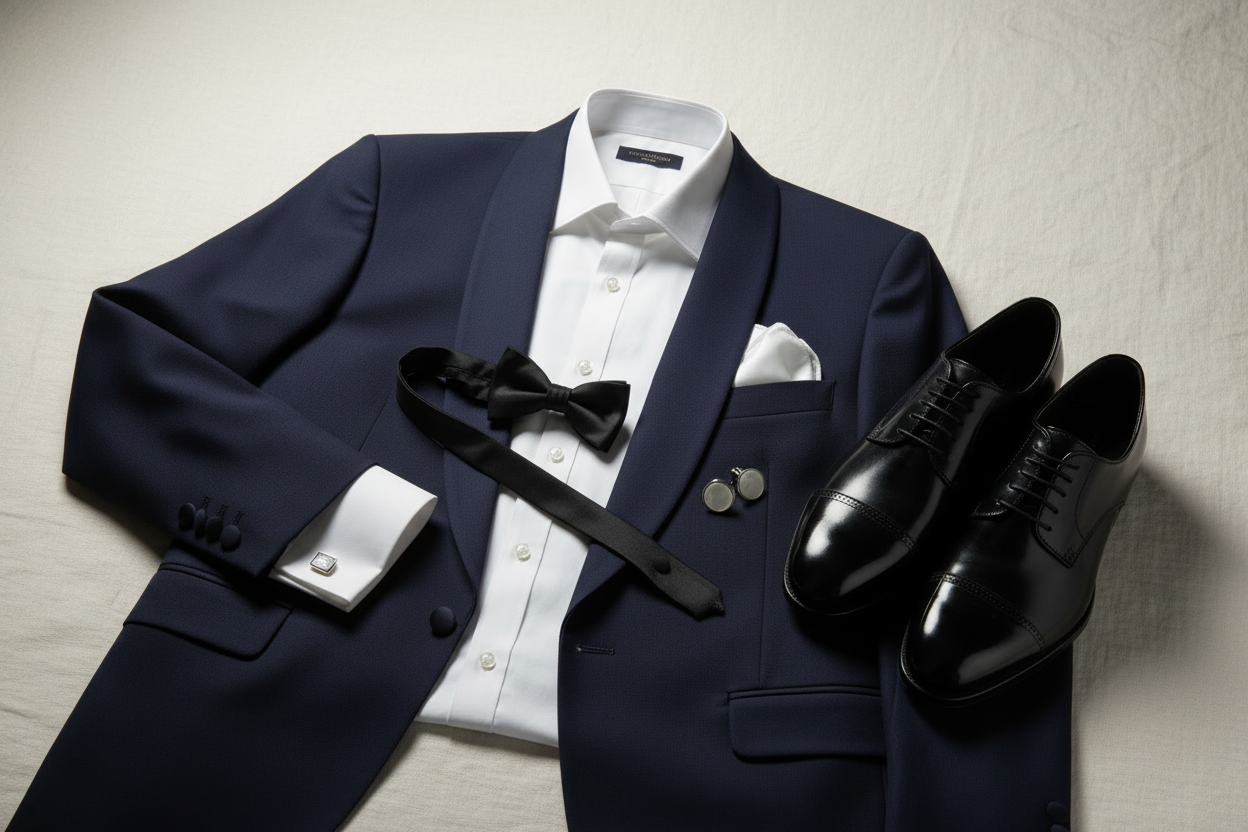
The complete ensemble (tuxedo version):
- Tuxedo with shawl or peak lapels, black or very dark midnight blue
- Pleated or piqué front shirt, wing or spread collar
- Black silk bow tie (never pre-tied)
- White silk or linen pocket square
- Patent leather or high-shine leather shoes
- Onyx or mother-of-pearl cufflinks
Knowing how to accessorize
An impeccable suit without carefully chosen accessories is like a sentence without punctuation. You understand the general meaning, but it lacks rhythm, nuance, and personality. It is in the details that the difference between "wearing a suit" and "having style" lies.
The tie:
The tie is the first thing the eye notices when looking at a man in a suit. It therefore deserves special attention.
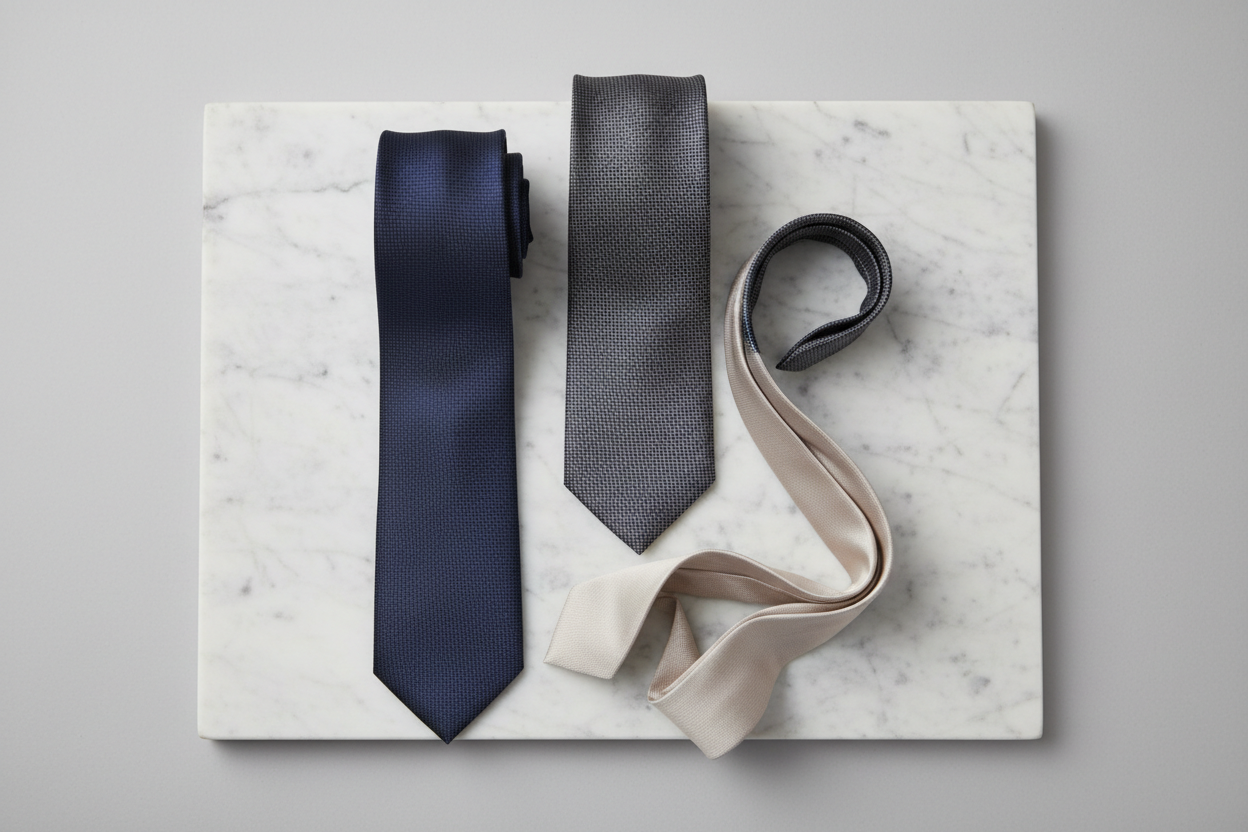
Material
Avoid smooth, shiny satin ties, which immediately call to mind a high school prom or a rented suit. For a wedding, opt for:
Grenadine silk: This distinctive weave (visible under a magnifying glass) offers a matte, grainy texture that absorbs light. A navy blue or burgundy grenadine is of unsurpassed elegance—formal enough for a chateau, yet subtle enough not to look like you are "trying too hard."
Woven silk (foulard, jacquard): Discreet patterns (micro-dots, paisley, geometric) add visual interest without descending into eccentricity.
Knit wool or silk: Perfect for countryside weddings or relaxed settings. The characteristic square end of a knit tie immediately breaks up the formality.
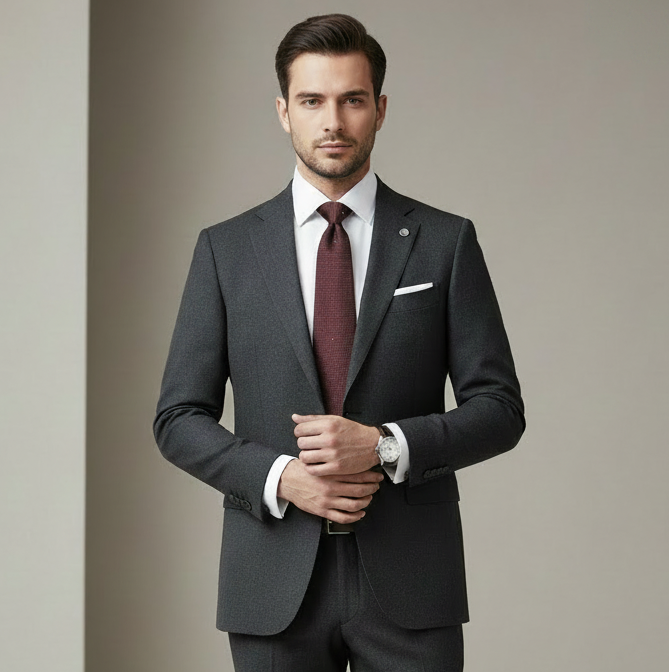
Width
Golden rule: your tie width should match your lapel width. An 8 cm tie on 6 cm lapels will create a visual imbalance. Conversely, a 5 cm slim tie on classic 8 cm lapels will make you look like a teenager who borrowed his father's suit.
At Anthony Garçon, our cuts feature lapels between 7 and 8.5 cm depending on the model—the ideal tie is therefore in the same range.
The pocket square: The extra touch that makes the difference
The pocket square is the accessory that instantly transforms a silhouette. Without it, the chest appears empty, unfinished. With it, the eye finds a focal point that structures the look.
The golden rule: never "matchy-matchy"
Forget the coordinated tie-and-pocket square sets sold in department stores immediately. Wearing a pocket square that matches your tie is the most common stylistic error—and the easiest to avoid.
How to choose:
The pocket square should echo a secondary color from your outfit, not the primary color. If you are wearing a midnight blue suit with a burgundy tie, your pocket square can incorporate a cream tone (recalling your shirt), a sky blue (a shade of your suit), or a pattern that includes burgundy without replicating it.
Another option: bold contrast. A white linen or cotton pocket square with a dark suit remains an unbeatable classic. It brings light to the face and works 100% of the time.
The fold:
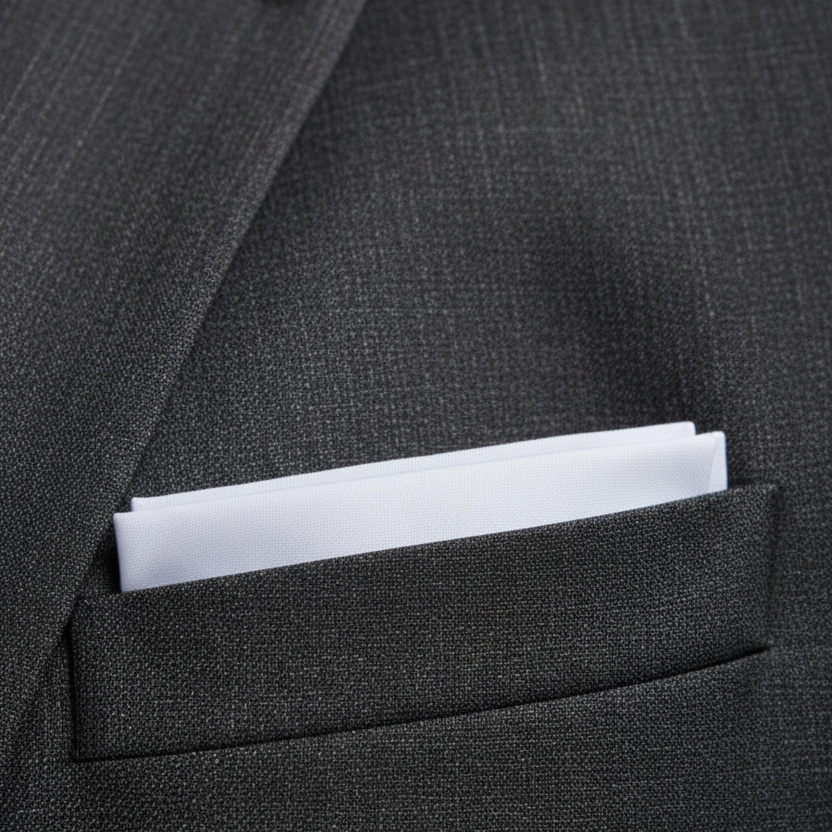
For a wedding, avoid overly elaborate folds (staircase, flower) which look like you're "trying too hard." Opt for the "TV fold" (a neat rectangle peeking out by 1 cm) for a crisp look, or the casual "puff" (pocket square loosely gathered) for a more nonchalant touch.
Cufflinks and belt
These often overlooked accessories contribute to the overall harmony of your outfit.
Cufflinks
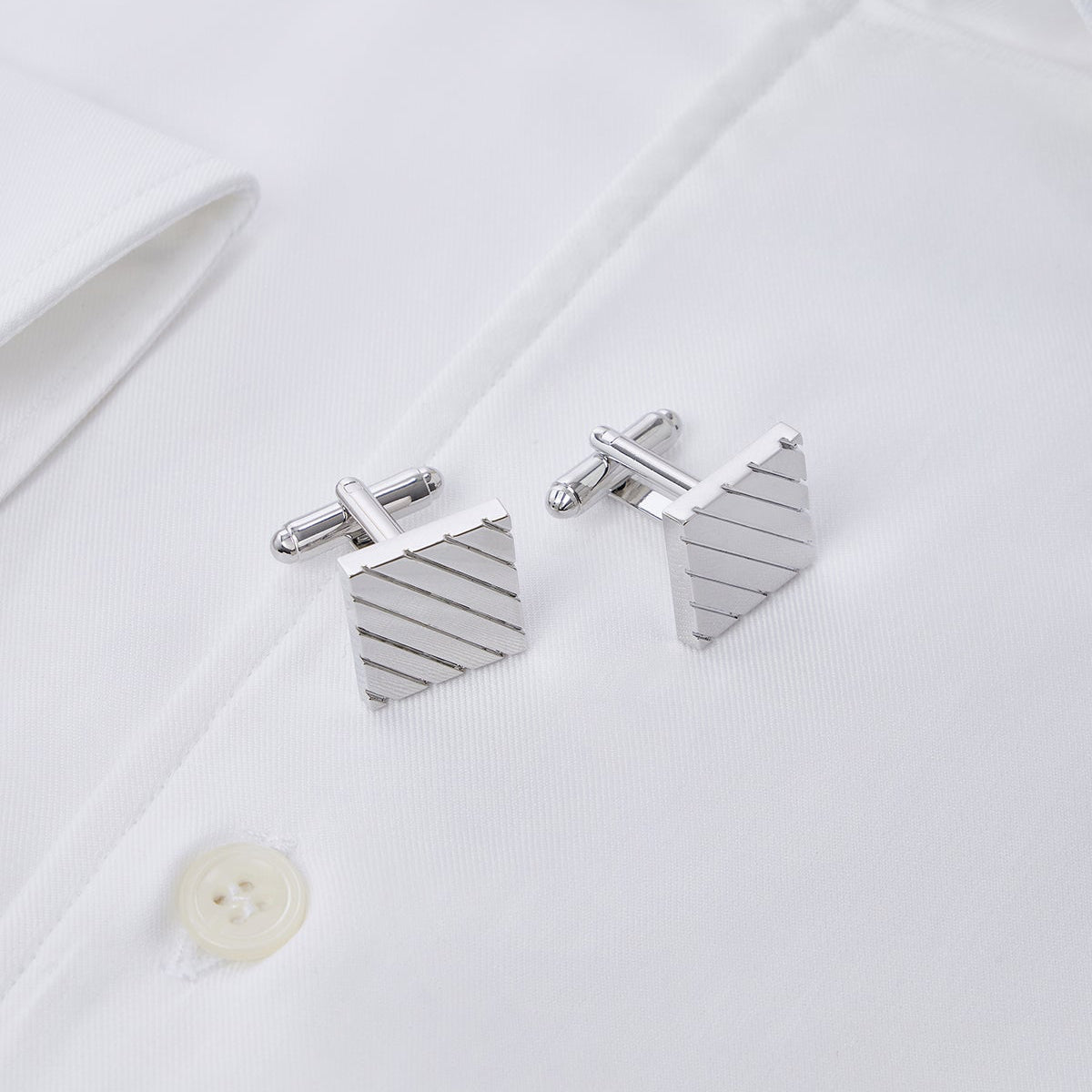
For a wedding, discretion is the order of the day. Forget novelty cufflinks (skulls, cartoon characters, brand logos). Favor classic shapes (ovals, silk knots, bars) in high-quality materials: silver, gold, mother-of-pearl, onyx.
Your cufflinks should be in the same metal as your watch and belt buckle. If you are wearing a watch with a steel case, opt for silver-toned cufflinks. If your watch is in yellow or rose gold, coordinate your cufflinks accordingly.
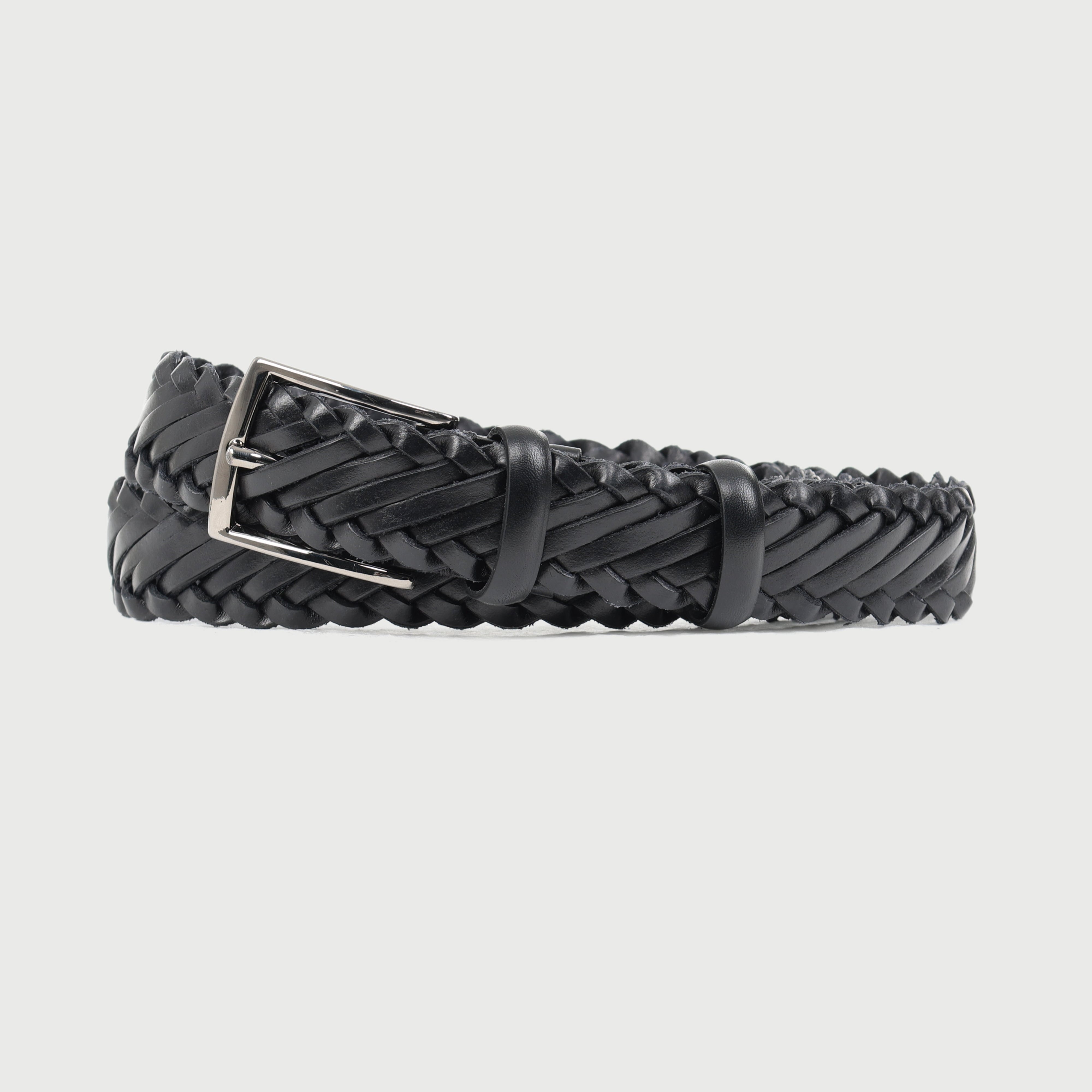
The belt
A suit belt must be slim (3 to 3.5 cm maximum), made of smooth leather, and feature a discreet buckle. Wide belts with large buckles are reserved for jeans and casual outfits.
The same logic of consistency applies: choose a silver buckle if your watch is steel, and a gold one if your watch is gold. And of course, the color of the leather must match your shoes. Black with black, brown with brown, without exception.
How to manage your suit purchase before the big day
A wedding suit should not be bought at the last minute. Between choosing the style, fittings, and any necessary alterations, plan a realistic schedule to arrive at the big day perfectly prepared.
M-3: Choosing the style and the first fitting
Three months before the wedding, book an appointment at the boutique for your first fitting session. This is the time to:
Defining your needs:
Are you the groom, the best man, a close guest? Is the dress code specified on the invitation? What is the venue, the season, the general atmosphere?
Try on several cuts:
Even if you think you know what suits you, let yourself be surprised. A double-breasted suit you would never have considered might reveal an unsuspected silhouette.
Choosing the fabric:
Color, material, weight — these decisions should be made with a clear head, not in a rush.
Why three months?
This timeframe allows for ordering specific fabric if necessary, scheduling several fittings, and calmly managing any unforeseen circumstances (delivery delays, changes of mind, weight fluctuations).
M-1: Final alterations
One month before the wedding, your suit is ready but likely requires a few adjustments. The most common alterations:
Sleeve length: The shirt cuff should extend 1 to 1.5 cm beyond the jacket sleeve. No more (the "arms too short" effect), and no less (the "suit too big" effect).
Trouser break: The bottom of the trousers should graze the top of the shoe with a slight break (the fabric "breaking" over the leather). Too long, and the trousers look sloppy. Too short, and they reveal the sock—acceptable in summer, risky for a formal wedding.
Jacket waist suppression: If you have lost or gained weight since your first fitting, this is the time to adjust.
These alterations, performed by our dedicated tailors, make the difference between an "off-the-rack" suit and a silhouette truly tailored to your body shape.
D-7: The final full fitting
One week before the wedding, try on your entire outfit under real-world conditions:
Complete suit: Jacket, trousers, waistcoat if it is a three-piece.
Final shirt: Not just any shirt—the one you will wear on the big day.
All accessories: Tie or bow tie, pocket square, cufflinks, belt or suspenders, watch.
Shoes: Wear them to verify the final length of the trousers.
Perform wedding movements: Sit down, raise your arms, shake imaginary hands, mime a hug. Your suit must allow all these movements without restriction.
This is also the time to iron or steam if necessary, and to ensure everything is perfect. On the big day, all you will have to do is put on your outfit with the peace of mind of someone who knows they haven't forgotten a thing.