

Which suit to wear in spring?
The complete guide to combining elegance and lightness
What to wear in spring?
Spring marks a transition. Temperatures warm up, days get longer, and outfits become lighter. However, choosing a men's suit for this season requires a true balance: it must be light enough for comfort, while maintaining an elegant structure suitable for formal occasions.
Unlike winter, where warmth is the priority, a spring suit must meet more subtle constraints: temperature variations, humidity, and alternating indoor/outdoor wear.
In this guide, we explain how to choose the right suit for spring, based on materials, colors, cuts, and uses.

Why adapt your suit for spring?
Spring is a transitional season. A suit that is too light may lack structure on cool days, while a fabric that is too heavy quickly becomes uncomfortable.
A well-chosen spring suit allows you to:
- adapt to temperature variations,
- maintain a sharp and elegant silhouette,
- stay comfortable throughout the day,
- prepare for the transition to summer outfits.
The right choice depends above all on the material and weight of the fabric.
Which fabrics are best for a spring suit?
"4-season" wool: the perfect balance
Wool remains the gold standard, even in spring. But unlike in winter, we favor lighter wools here, often called "4-season wool."
They offer:
- good breathability,
- balanced thermal comfort,
- impeccable structure.
It is the ideal choice for a versatile suit, worn just as well at work as for events.
OUR WOOL SUITSWool, silk, or linen blends: suppleness and lightness
In spring, blended fabrics are particularly interesting. Combining wool with silk or linen makes for suits that are more supple, more breathable, and slightly textured.
These materials add a more vibrant touch to the suit, while maintaining a certain structure.
Linen (in moderation)
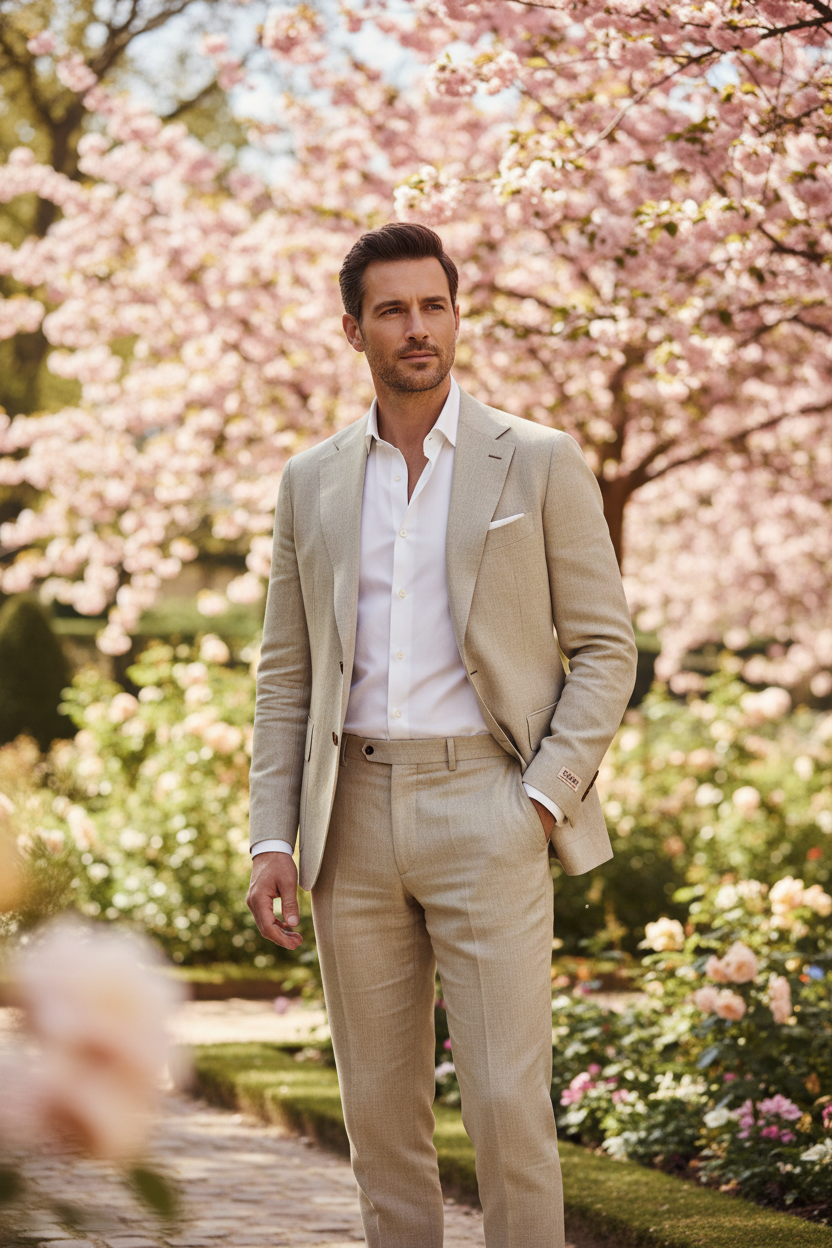
Linen can be worn in the spring, but it remains better suited to summer. Its lightness is pleasant, but its wrinkled appearance may be less appropriate for formal contexts.
Best reserved for more casual looks or outdoor events.
What colors should you wear in spring?
Spring is the ideal season to shift your palette toward brighter tones, without veering into colors that are too summery.
Blue remains a safe bet, especially in lighter or slightly textured shades. Mid-gray is also very suitable, offering an elegant and modern look.
Softer hues, such as certain slightly faded blues or luminous grays, provide a sense of freshness while maintaining a certain sobriety.
The goal is not to radically transform your style, but to gradually adapt it to the season.
Which suit cut should you choose for spring?
In spring, the cut should remain structured while allowing more freedom than in winter.
A slim or semi-slim fit is often ideal. It allows for an elegant silhouette without stiffness, while adapting to lighter layering.
The 2-piece suit is generally preferred as it offers more flexibility. The 3-piece remains an option, but more for formal occasions such as a wedding.
How to wear a suit in spring?
Spring is a season where temperature fluctuations require a certain level of adaptability.
It is often wise to opt for light layering. A well-chosen shirt may suffice, but a waistcoat or fine knit can complete the outfit on cooler days.
The choice of coat must also be adapted: a trench coat or light coat is preferable to pieces that are too wintry.
Shoes remain classic, but can evolve towards slightly more flexible and less rigid styles than those worn in winter.
Spring suit: for what occasions?
For work
A lightweight wool suit in a blue or grey shade is perfectly suited for daily use. It offers a good balance between elegance and comfort.
BUSINESS SUITSFor a spring wedding
Spring is a very popular season for weddings. Suits can be lighter in color, while still maintaining an elegant structure.
OUR WEDDING SUITSFor a formal occasion
A well-tailored suit, in a breathable fabric and a sophisticated color, remains the best option.
Mistakes to avoid with a spring suit
- Choosing a fabric that is too thick
- Opting for an outfit that is too summery (too much linen, colors that are too light)
- Neglecting temperature fluctuations
- Wearing a cut that is too rigid or too heavy
A spring suit must remain balanced, adaptable, and comfortable.
FAQ – Men's Spring Suit
Lightweight wool or wool-silk blends are most suitable.
Yes, but more for casual occasions.
Blue and grey remain the most versatile options.